IBM, Netflix, and Conde Nast. What do these corporations have in common? Their core business represents a digital transformation and disruption trend in organizations. They are leveraging talent with PMP certifications (IBM: around 5%, Netflix: around 11%, Conde Nast: between 1-3%, Source: LinkedIn). Project managers are in demand in a variety of industries. “Although quite common in the IT field, project-oriented work is also common in business services, oil and gas, finance and insurance, manufacturing, construction, and utility industries—all over the world” (https://www.simplilearn.com/why-should-you-choose-project-management-as-a-career-ccr40-article). Ironically, I myself, as a certified project management professional and practitioner have worked in 4 of these 6 industry sectors myself.
The purpose of this article is to discuss how organizations that utilize more project managers are better able to balance capacity and demand.
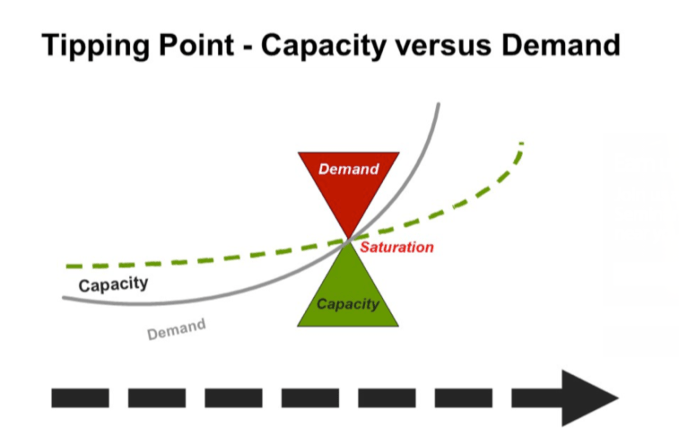
For a reference, please see the diagram presented from project management.com included in this posting. Over time, organizations are placed in precarious positions and face trade offs of how to balance capacity and demand. This unavoidable situation is demonstrated by the two triangles and the progression of time across the bottom of diagram. In economic terms, this diagram can be interpreted as a business cycle from the perspective of a single organization.
The ten ways project managers are able to achieve balance capacity and demand: (these are tools I have been successful with in my current and past 17 organizations.)
- Decreasing the amount of time to make business decisions (i.e. stopping bottlenecks) using change control tools of the change management plan, configuration management and project integration management process we account for changes to deliverables in a holistic manner.
- Creating methods to adapt to change with performance indicators crafted from scope, cost, and schedule baselines
- Instituting problem solving tools in systematic manner (Steps include: define the problem, identify the root-cause, generate possible solutions, choosing the best solution, implementing the solution, and verifying solution effectiveness)
- Increasing the likely of automation because project management has always enjoyed some level of automation (in the form of “Microsoft Project” software, projectmanagement.com). All a result, certified project managers give organizations the tools to increase transparency of operations and increase their economies to scale.
- Bringing information to the highest value of use by integrating knowledge domains and by managing project knowledge in lessons learned repositories
- Connecting stakeholders to the project team and those who are perceived to be or are affected by project work thereby minimizing bottlenecks and work stoppage
- Creating tools to build consensus regarding project work and balancing resource capacity by analyzing resource breakdown structures, estimating activity durations, and estimating activity resources
- Tying project work to the business success metrics in the form of business cases and tying project requirements to the project deliverables that satisfy them in the form of requirements documentation and requirements traceability matrixes which gives clarity on the capacity of the organization to grow in the matter it has determined
- Advocating the use of technology and project management information systems to reduce waste (in a lean matter, with highly skilled workers as illustrated in the diagram line for “Capacity”)
- Championing the use of business enterprise resource planning systems to increase response to customer demand (in project management, practitioners tailor the delivery of projects depending on the needs of the organization and the customer, as illustrated in the diagram as the trend line for “Demand”)
Project Managers are skilled at managing the ten knowledge areas of Project Integration Management, Project Scope Management, Project Schedule Management, Project Cost Management, Project Quality Management, Project Resource Management, Project Communications Management, Project Risk Management, Project Procurement Management, and Project Stakeholder Management which are alluded to in #1-10 of this post.
As a community of practitioners, certified project management professionals, like myself, understand how 100% of these knowledge areas work together to insure that organizations like Netflix, IBM, and Conde Nast excel at balancing capacity and demand.
Comments or questions? Message me at my LinkedIn page: linkedin.com/in/emiakiode
Emi Akiode is available for private consulting opportunities.
Created and curated by Emi Akiode, PMP
 pmp-101.com
One thought on “10 Ways Project Managers Have Advanced Companies in Various Industries”